Commercial property roof information • Hayward, CA
Commercial roofing concerns in Industrial Technology and Innovation Corridor and airport-related businesses
Hayward has a substantial industrial corridor with distribution, food manufacturing, bioscience and technology properties alongside neighborhood retail and downtown offices. A large warehouse may have a metal or membrane roof with many field laps and drains; a food-processing facility may have mechanical exhaust and sanitation-sensitive storage, while a business near the airfield may have special operating-access considerations.
Winter rainstorms can reveal weaknesses at long-span roof seams, equipment curbs and aging drain seals. Bay-adjacent moisture and periods of high rooftop traffic can affect maintenance planning, though they do not diagnose a particular roof.
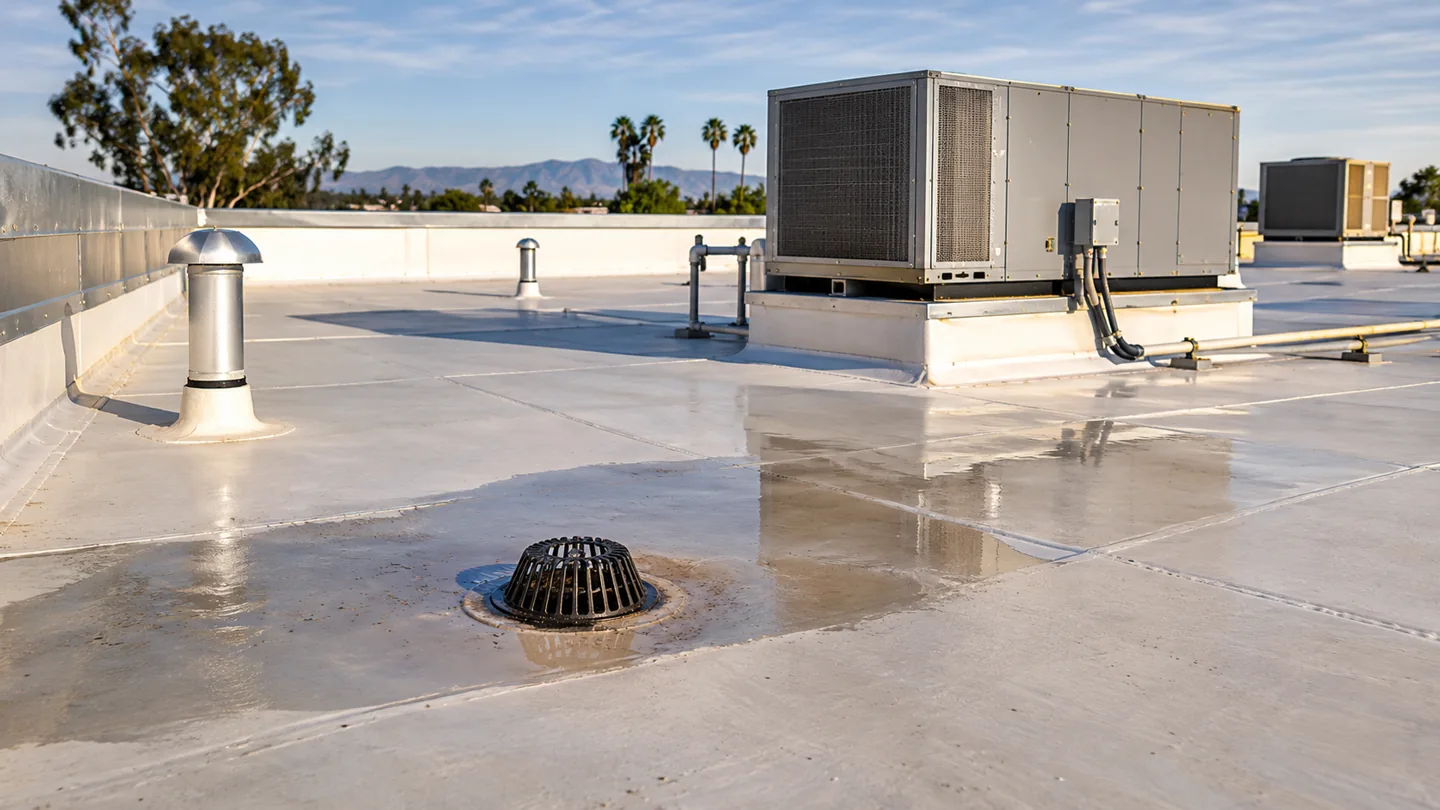
Illustrative commercial roof imagery, not a verified customer site or completed project in Hayward.
Inspection example: tracing where water may have entered
Consider a hypothetical food-handling warehouse off Industrial Boulevard where rainwater appears above a packaging corridor. Inspection would map the location, isolate any refrigerant or condensate line issue, then inspect the closest drain basin, seam transitions and exhaust curbs while maintaining sanitation boundaries. This hypothetical illustration is provided for inspection planning; it is not a completed project or a description of an actual customer property.
Evaluate single-ply seam welds, fastener penetrations in metal roofs, roof hatch and exhaust curb details, internal drains and membrane puncture patterns along maintenance walkways. Roof covering, manufacturer requirements and existing warranty conditions need to be identified before choosing materials or testing methods.
Repair areas related to this property context
The following commercial roof services correspond to details described on this page. A roofing professional must verify the actual water-entry route and whether the covering is TPO, PVC, EPDM, metal, built-up roofing or another assembly.
Pipes, conduits, supports and roof-mounted equipment interrupt the waterproofing plane. Poorly detailed penetrations can leak even when surrounding roofing is intact.
HVAC curbs, duct penetrations and service activity can compromise roofing details. Water may enter around the unit even when the membrane field is sound.
Inspection focus: Evaluate curbs, counterflashings, service penetrations and nearby traffic damage.
Exposed fasteners, washers and attachment points may loosen or deteriorate over time. Repair should address the attachment and the surrounding waterproofing detail.
Inspection focus: Inspect fastener backing, washers, corrosion, movement and panel or membrane compatibility.
Flashing directs water away from changes in roof plane and adjoining construction. Failed counterflashing, terminations or sealant joints can create recurring interior leaks.
Inspection focus: Trace water paths around parapets, curbs, walls, edges and expansion points.
Deciding which repair is suitable
If leakage follows one mechanical penetration, a targeted flashing repair may be appropriate; if widespread drain basin moisture is found, investigate wet insulation and slope adequacy before estimating scope.
Leaking refrigeration or HVAC condensate can mimic a roof leak at food or cold-storage facilities.
A ceiling stain alone does not show whether insulation is wet or whether a full roof replacement is needed. Confirm affected roof layers and the extent of the issue through appropriate inspection.
Records that help narrow the roof leak
Collect sanitation or tenant safety rules, roof service logs, dock operating schedules, leak photographs and information about recent equipment installation.
Planning rooftop access and business continuity
Schedule work around dock shifts, food safety controls and restricted mechanical areas. Keep roof debris and wet materials clear of occupied or sanitary zones. Document symptoms from safe indoor areas. Avoid unsupervised roof access, particularly around wet surfaces, fall exposures or energized equipment.
Record leak timing and whether rain, wind or mechanical equipment operation coincided with it.
Photograph visible indoor water damage from a safe location.
Find roof plans, system/warranty information and previous repair records if available.
Keep people and inventory away from active drips and affected electrical fixtures.
Verify independent provider coverage, licensing, insurance and the work scope directly.
Discuss a commercial roof leak in Hayward
Call with the city, roof type, affected room and leak timing. This referral site may connect you with an independent professional; it does not represent a local office or guarantee coverage or appointment timing in Hayward.
How is a commercial roof leak diagnosed at a Hayward warehouse with rooftop equipment?
A professional should compare roof layout with the interior leak, evaluate drains, seams and penetrations, and rule out rooftop condensate piping before specifying any membrane repair.
What information should be shared before requesting a roof inspection in Hayward?
Share the roof material if known, leak timing, indoor location and any recent rooftop alterations. Collect sanitation or tenant safety rules, roof service logs, dock operating schedules, leak photographs and information about recent equipment installation.
Can an independent roofing professional be contacted for a Hayward property?
Call (833) 586-3848 with the building location and roof symptoms. Availability, license, insurance, appointment timing and scope must be confirmed directly with a participating independent professional.