Alameda County • West San Leandro industrial and commercial corridors
Commercial Roof Leak Repair in San Leandro, California
Commercial property roof leak concerns near West San Leandro industrial district, Marina Boulevard, Davis Street, East 14th Street and the Bay Fair commercial area. Explore local building contexts, roof assemblies and appropriate inspection questions.
Commercial property roof information • San Leandro, CA
Commercial roofing concerns in West San Leandro industrial and commercial corridors
San Leandro contains industrial and food-related buildings, warehousing, neighborhood retail and office properties. Long low-slope industrial roofs may combine aged membrane sections with equipment-mounted penetrations; storefront and mixed-use roofs near East 14th Street often require careful parapet and drainage investigation rather than broad replacement assumptions.
Cool-season rains and wind can reveal degraded drain seals or parapet joints, particularly where several roof additions meet. Actual failure modes depend on assembly age and past alterations, not the city alone.
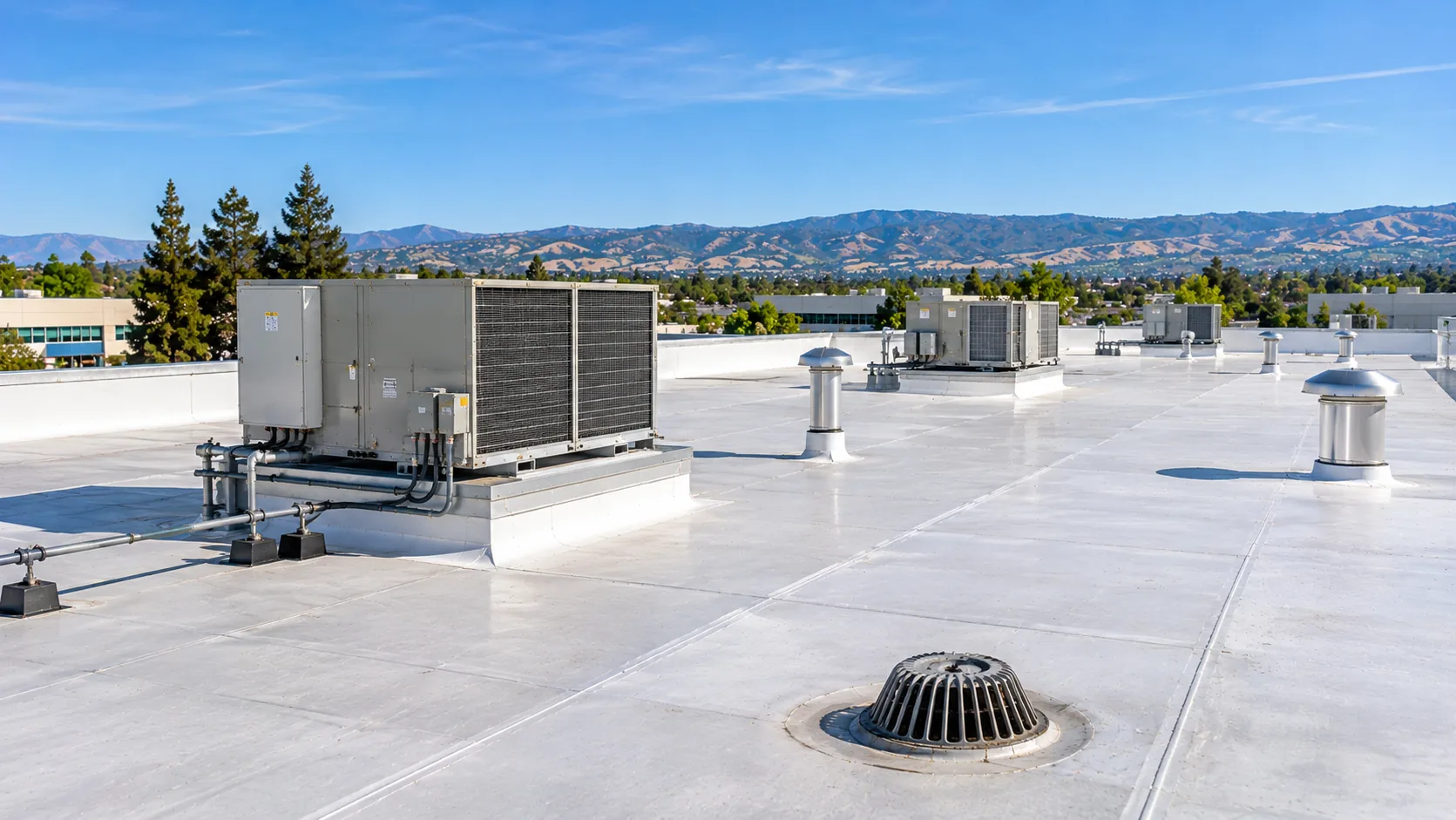
Illustrative commercial roof imagery, not a verified customer site or completed project in San Leandro.
Inspection example: tracing where water may have entered
At a hypothetical light-industrial property near Marina Boulevard, moisture appears along an interior perimeter wall after a windy storm. Assessment would compare roof edge metal, counterflashing, parapet coping and nearby roof drains with the wall cladding before attributing the symptom to the membrane. This hypothetical illustration is provided for inspection planning; it is not a completed project or a description of an actual customer property.
Review wall-to-roof intersections, termination bars, roof-edge fasteners, internal gutters and drain clamps; identify whether legacy BUR, modified bitumen or single-ply material is present. Roof covering, manufacturer requirements and existing warranty conditions need to be identified before choosing materials or testing methods.
Repair areas related to this property context
The following commercial roof services correspond to details described on this page. A roofing professional must verify the actual water-entry route and whether the covering is TPO, PVC, EPDM, metal, built-up roofing or another assembly.
Flashing directs water away from changes in roof plane and adjoining construction. Failed counterflashing, terminations or sealant joints can create recurring interior leaks.
Inspection focus: Trace water paths around parapets, curbs, walls, edges and expansion points.
Modified bitumen systems can leak through failed laps, splits, blisters, flashing transitions or damaged cap sheets. Repair methods vary with the existing system.
Inspection focus: Assess lap adhesion, surface condition, underlying moisture and the compatibility of patch materials.
Built-up roofs consist of multiple plies and surfacing. Leaks can involve splits, deteriorated flashing, blisters or water trapped within the assembly.
Inspection focus: Inspect the condition of the felts, gravel or coating, flashings and possible saturated insulation.
Deciding which repair is suitable
A failed edge-flashing section may be localized, while multiple aging transitions could justify a wider condition survey; choose a scope only after confirming substrate and affected area.
A stain near the roof edge may be caused by a façade penetration or coping joint rather than the main roof field.
A ceiling stain alone does not show whether insulation is wet or whether a full roof replacement is needed. Confirm affected roof layers and the extent of the issue through appropriate inspection.
Records that help narrow the roof leak
Gather drawings of parapet and roof-edge details, records of exterior façade work, roof warranty information and reports of which wall sections became wet.
Planning rooftop access and business continuity
Secure access near delivery lanes, protect retail storefront entries and check tenant responsibility for shared roof zones before arranging repairs. Document symptoms from safe indoor areas. Avoid unsupervised roof access, particularly around wet surfaces, fall exposures or energized equipment.
Record leak timing and whether rain, wind or mechanical equipment operation coincided with it.
Photograph visible indoor water damage from a safe location.
Find roof plans, system/warranty information and previous repair records if available.
Keep people and inventory away from active drips and affected electrical fixtures.
Verify independent provider coverage, licensing, insurance and the work scope directly.
Discuss a commercial roof leak in San Leandro
Call with the city, roof type, affected room and leak timing. This referral site may connect you with an independent professional; it does not represent a local office or guarantee coverage or appointment timing in San Leandro.
Why does a San Leandro commercial roof leak appear only near an outside wall?
Possible sources include parapet coping, counterflashing, termination bars and exterior cladding joints. The investigation should follow the wall and roof intersection, not only patch the membrane beneath the stain.
What information should be shared before requesting a roof inspection in San Leandro?
Share the roof material if known, leak timing, indoor location and any recent rooftop alterations. Gather drawings of parapet and roof-edge details, records of exterior façade work, roof warranty information and reports of which wall sections became wet.
Can an independent roofing professional be contacted for a San Leandro property?
Call (833) 586-3848 with the building location and roof symptoms. Availability, license, insurance, appointment timing and scope must be confirmed directly with a participating independent professional.