Santa Clara County • Downtown, North San Jose and south valley commercial centers
Commercial Roof Leak Repair in San Jose, California
Commercial property roof leak concerns near North San Jose along North First Street, the Berryessa area, Downtown San Jose and the Monterey Road industrial corridor. Explore local building contexts, roof assemblies and appropriate inspection questions.
Commercial property roof information • San Jose, CA
Commercial roofing concerns in Downtown, North San Jose and south valley commercial centers
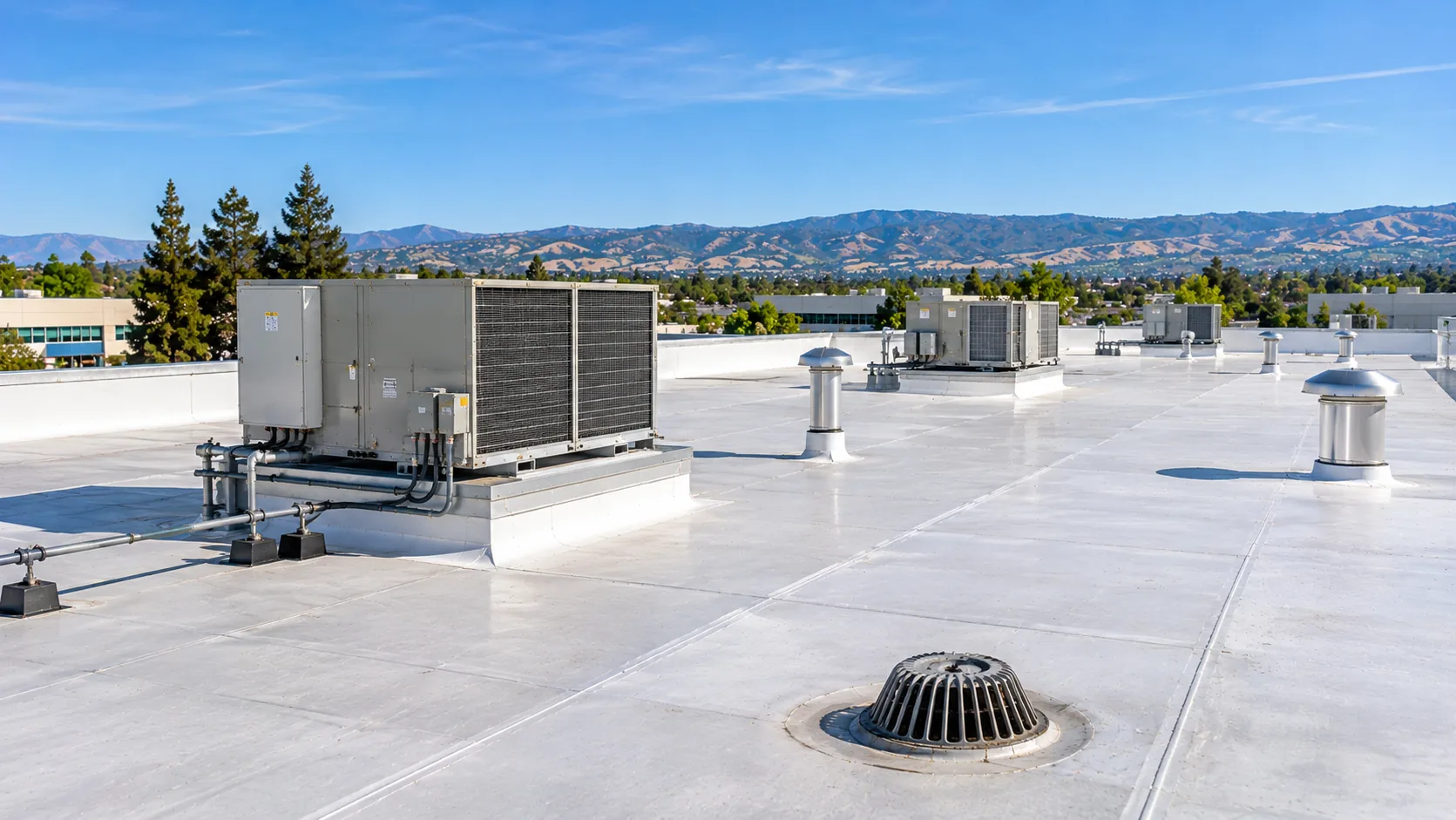
San Jose spans downtown office towers, North San Jose research and industrial campuses, neighborhood shopping centers, medical facilities and southern industrial buildings. Roof geometries may include large low-slope membranes, multiple mechanical platforms, metal service structures and older multi-layer assemblies. A single moisture stain is not sufficient to determine whether intrusion came from a membrane seam, parapet edge, condensate line or equipment curb.
Rainfall concentrates in the cooler season. After dry months, debris accumulation at internal drains and deteriorated sealants around rooftop equipment may become apparent during the first heavy storm; those are inspection possibilities, not a diagnosis of every San Jose roof.
Illustrative commercial roof imagery, not a verified customer site or completed project in San Jose.
Inspection example: tracing where water may have entered
At a hypothetical North First Street office and R&D building, ceiling water appears in a corridor after the first sustained seasonal storm. The roof plan shows multiple HVAC curbs above the affected bay and an internal drain farther upslope. A professional would compare interior staining with the roof drainage direction, check curb-to-membrane details, and verify whether the condensate system is operating correctly. This hypothetical illustration is provided for inspection planning; it is not a completed project or a description of an actual customer property.
On large low-slope roofs, inspect membrane terminations, drains and overflow pathways, penetrations serving laboratory or office equipment, and wall transitions. Use manufacturer-compatible methods only after identifying TPO, PVC, EPDM or the existing built-up assembly. Roof covering, manufacturer requirements and existing warranty conditions need to be identified before choosing materials or testing methods.
Repair areas related to this property context
The following commercial roof services correspond to details described on this page. A roofing professional must verify the actual water-entry route and whether the covering is TPO, PVC, EPDM, metal, built-up roofing or another assembly.
Pipes, conduits, supports and roof-mounted equipment interrupt the waterproofing plane. Poorly detailed penetrations can leak even when surrounding roofing is intact.
HVAC curbs, duct penetrations and service activity can compromise roofing details. Water may enter around the unit even when the membrane field is sound.
Inspection focus: Evaluate curbs, counterflashings, service penetrations and nearby traffic damage.
Flashing directs water away from changes in roof plane and adjoining construction. Failed counterflashing, terminations or sealant joints can create recurring interior leaks.
Inspection focus: Trace water paths around parapets, curbs, walls, edges and expansion points.
Deciding which repair is suitable
Document the drainage area and all plausible entry points before prescribing a patch. Where leakage is recurrent, moisture surveying and controlled opening may be required to distinguish isolated flashing failure from saturated insulation.
Not every drip below a rooftop HVAC unit indicates an exterior roof defect; condensate, piping and mechanical drains may produce similar symptoms.
A ceiling stain alone does not show whether insulation is wet or whether a full roof replacement is needed. Confirm affected roof layers and the extent of the issue through appropriate inspection.
Records that help narrow the roof leak
Ask for roof plans, previous membrane repair locations, rooftop unit maintenance logs and a record of which rooms leaked during each rain event.
Planning rooftop access and business continuity
Confirm campus security, rooftop equipment access, fall-protection requirements and any change-control procedures before inspecting a data-sensitive or occupied research facility. Separate noisy work from critical production and tenant operations. Document symptoms from safe indoor areas. Avoid unsupervised roof access, particularly around wet surfaces, fall exposures or energized equipment.
Record leak timing and whether rain, wind or mechanical equipment operation coincided with it.
Photograph visible indoor water damage from a safe location.
Find roof plans, system/warranty information and previous repair records if available.
Keep people and inventory away from active drips and affected electrical fixtures.
Verify independent provider coverage, licensing, insurance and the work scope directly.
Discuss a commercial roof leak in San Jose
Call with the city, roof type, affected room and leak timing. This referral site may connect you with an independent professional; it does not represent a local office or guarantee coverage or appointment timing in San Jose.
Why can a San Jose office roof leak show up far from the damaged membrane?
Water can migrate along decking, insulation joints or utility penetrations before emerging inside. The roofer should correlate ceiling stains, roof slope, drains and equipment layouts rather than patching directly above the stain.
What information should be shared before requesting a roof inspection in San Jose?
Share the roof material if known, leak timing, indoor location and any recent rooftop alterations. Ask for roof plans, previous membrane repair locations, rooftop unit maintenance logs and a record of which rooms leaked during each rain event.
Can an independent roofing professional be contacted for a San Jose property?
Call (833) 586-3848 with the building location and roof symptoms. Availability, license, insurance, appointment timing and scope must be confirmed directly with a participating independent professional.