Santa Clara County • Silicon Valley technology campuses and event properties
Commercial Roof Leak Repair in Santa Clara, California
Commercial property roof leak concerns near Central Expressway, Great America Parkway, Bowers Avenue, the Northside technology district and the area around Levi's Stadium. Explore local building contexts, roof assemblies and appropriate inspection questions.
Commercial property roof information • Santa Clara, CA
Commercial roofing concerns in Silicon Valley technology campuses and event properties
The City of Santa Clara contains high-tech workplaces, laboratory and office complexes, hospitality, retail, and entertainment facilities. Roofs on these sites may carry densely spaced HVAC curbs, exhaust systems, fall-protection equipment and tenant-installed penetrations. Facilities teams need to determine whether water comes from roof flashings, repeated service traffic or a plumbing source, not assume an entire campus has one roof specification.
Seasonal winter rain can reveal vulnerable joint details at penetrations and parapets after prolonged dry periods. In large buildings, wetting patterns may reflect roof slope and internal drainage rather than where a stain appears indoors.
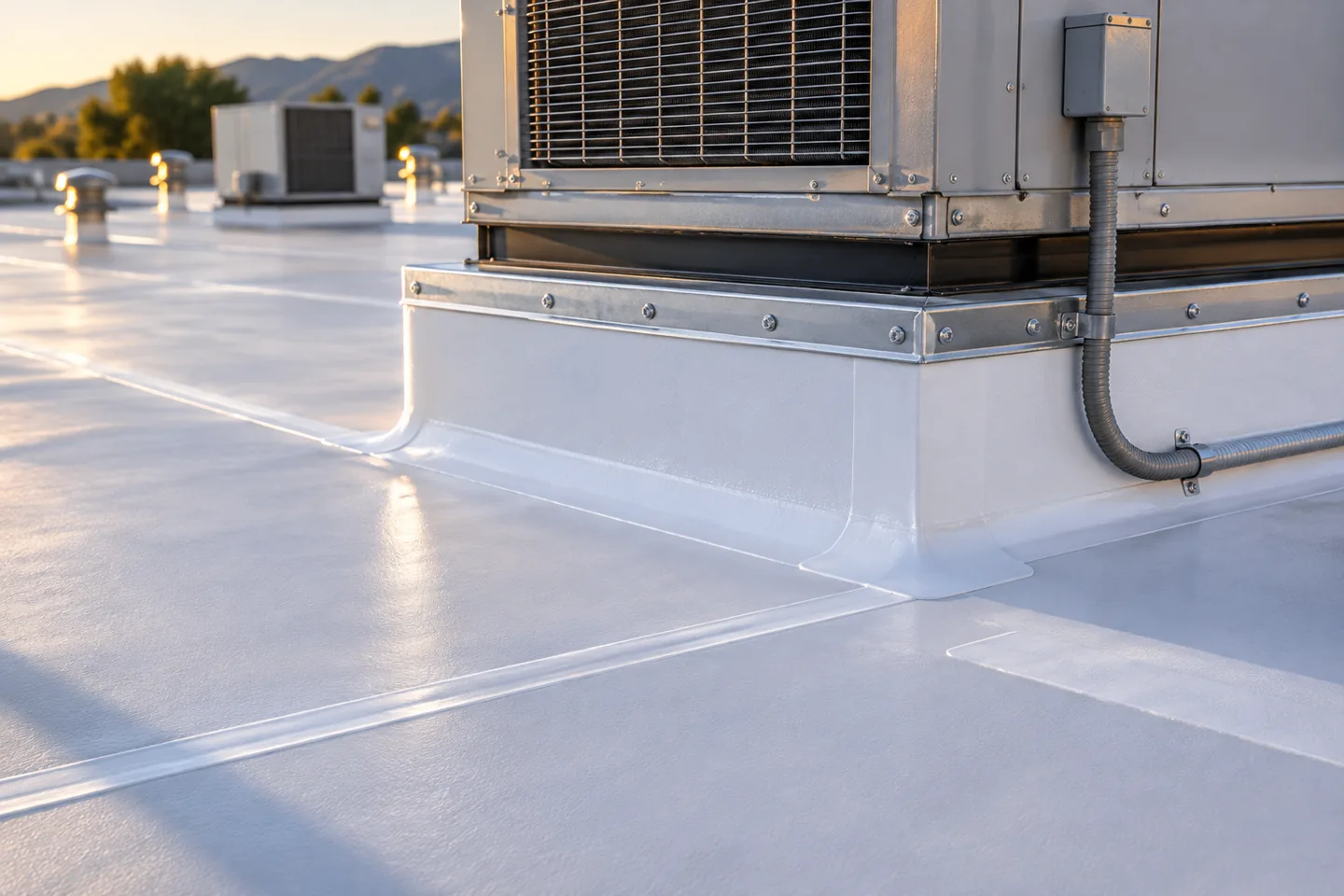
Illustrative commercial roof imagery, not a verified customer site or completed project in Santa Clara.
Inspection example: tracing where water may have entered
A hypothetical multi-tenant building near Great America Parkway reports moisture after a storm in the corridor beneath multiple mechanical ducts. An assessment would map active rooftop equipment, examine curb corner welds and counterflashing, and check drainage outlets before specifying an isolated repair. This hypothetical illustration is provided for inspection planning; it is not a completed project or a description of an actual customer property.
Inspect HVAC curb transitions, welds on single-ply field seams, expansion-joint crossings between building sections, and internal drain clamping rings. Where there are incompatible past patches, identify the membrane material before selecting sealants or repair patches. Roof covering, manufacturer requirements and existing warranty conditions need to be identified before choosing materials or testing methods.
Repair areas related to this property context
The following commercial roof services correspond to details described on this page. A roofing professional must verify the actual water-entry route and whether the covering is TPO, PVC, EPDM, metal, built-up roofing or another assembly.
HVAC curbs, duct penetrations and service activity can compromise roofing details. Water may enter around the unit even when the membrane field is sound.
Inspection focus: Evaluate curbs, counterflashings, service penetrations and nearby traffic damage.
Pipes, conduits, supports and roof-mounted equipment interrupt the waterproofing plane. Poorly detailed penetrations can leak even when surrounding roofing is intact.
Flashing directs water away from changes in roof plane and adjoining construction. Failed counterflashing, terminations or sealant joints can create recurring interior leaks.
Inspection focus: Trace water paths around parapets, curbs, walls, edges and expansion points.
A repair decision should consider whether the leak is confined to one transition or related to several repeated details on the same roof. Follow manufacturer guidance and preserve existing roof warranties.
Rooftop equipment condensate and membrane penetration leaks can coincide; investigate both without assuming a single cause.
A ceiling stain alone does not show whether insulation is wet or whether a full roof replacement is needed. Confirm affected roof layers and the extent of the issue through appropriate inspection.
Records that help narrow the roof leak
Collect the tenant build-out schedule, roof penetration approval history, equipment curbs, and any past roof warranty repair notices.
Planning rooftop access and business continuity
Arrange access through the property manager, document rooftop equipment responsibilities between tenants, and keep emergency routes clear around event or hotel buildings. Document symptoms from safe indoor areas. Avoid unsupervised roof access, particularly around wet surfaces, fall exposures or energized equipment.
Record leak timing and whether rain, wind or mechanical equipment operation coincided with it.
Photograph visible indoor water damage from a safe location.
Find roof plans, system/warranty information and previous repair records if available.
Keep people and inventory away from active drips and affected electrical fixtures.
Verify independent provider coverage, licensing, insurance and the work scope directly.
Discuss a commercial roof leak in Santa Clara
Call with the city, roof type, affected room and leak timing. This referral site may connect you with an independent professional; it does not represent a local office or guarantee coverage or appointment timing in Santa Clara.
What should be checked first when a Santa Clara commercial building leaks around rooftop equipment?
The curb perimeter, flashing terminations, adjacent seams and condensate drainage should be inspected together, then correlated with the indoor leak position.
What information should be shared before requesting a roof inspection in Santa Clara?
Share the roof material if known, leak timing, indoor location and any recent rooftop alterations. Collect the tenant build-out schedule, roof penetration approval history, equipment curbs, and any past roof warranty repair notices.
Can an independent roofing professional be contacted for a Santa Clara property?
Call (833) 586-3848 with the building location and roof symptoms. Availability, license, insurance, appointment timing and scope must be confirmed directly with a participating independent professional.