Santa Clara County • Moffett Park and Mathilda Avenue office/R&D districts
Commercial Roof Leak Repair in Sunnyvale, California
Commercial property roof leak concerns near Moffett Park, Mathilda Avenue, Lawrence Expressway, El Camino Real and Sunnyvale industrial business parks. Explore local building contexts, roof assemblies and appropriate inspection questions.
Commercial property roof information • Sunnyvale, CA
Commercial roofing concerns in Moffett Park and Mathilda Avenue office/R&D districts
Sunnyvale combines research campuses, multi-tenant offices, clean-tech and electronics operations, neighborhood retail, and commercial buildings along the Moffett Park and Lawrence corridors. Different roof zones may carry process exhaust, cooling equipment, solar equipment and numerous field joints. A roof leak investigation should distinguish mechanical service pathways from seam failures and preserve operational access to sensitive workplaces.
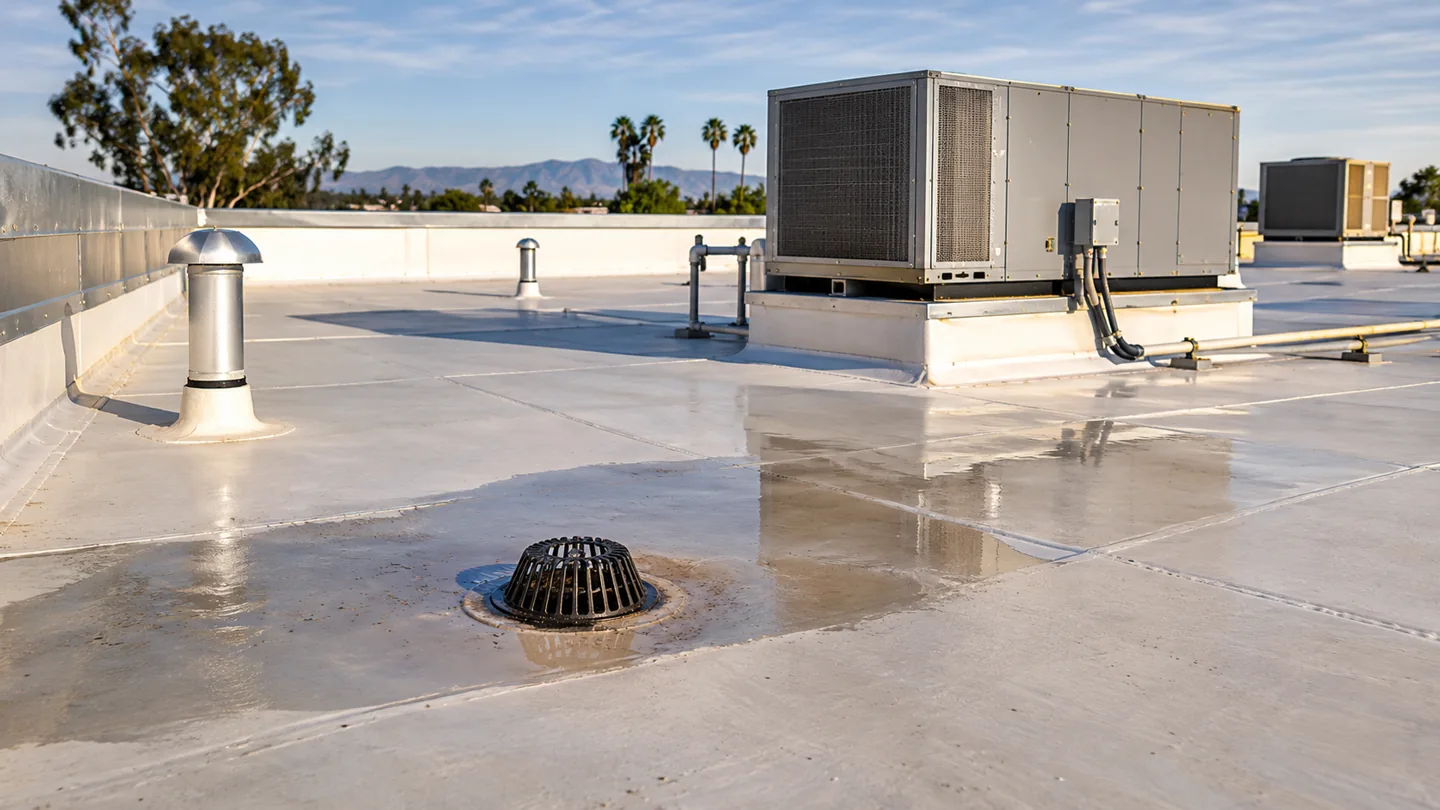
In the cooler wet season, standing water around blocked drains and mechanical support platforms can expose weaknesses after otherwise dry periods. The actual drainage slope and assembly condition should be measured rather than inferred from the city climate alone.
Illustrative commercial roof imagery, not a verified customer site or completed project in Sunnyvale.
Inspection example: tracing where water may have entered
In a hypothetical Moffett Park technology building, water is spotted near a server-room corridor during a storm. A professional would coordinate building systems protection, identify roof drains and HVAC platforms over the zone, then inspect membrane laps and equipment-stand penetrations without disrupting critical electrical operations. This hypothetical illustration is provided for inspection planning; it is not a completed project or a description of an actual customer property.
Evaluate TPO/PVC heat-welded seams where present, equipment curb flashings, parapet terminations and traffic pads on regularly serviced roofs. Test suspect areas using methods suitable for the existing assembly. Roof covering, manufacturer requirements and existing warranty conditions need to be identified before choosing materials or testing methods.
Repair areas related to this property context
The following commercial roof services correspond to details described on this page. A roofing professional must verify the actual water-entry route and whether the covering is TPO, PVC, EPDM, metal, built-up roofing or another assembly.
Open seams and compromised laps can let water enter a commercial roof system. The appropriate repair depends on whether the roof uses welded, bonded, mechanically fastened or asphaltic joints.
Inspection focus: Identify the exact seam system, separation extent and moisture conditions before repair.
HVAC curbs, duct penetrations and service activity can compromise roofing details. Water may enter around the unit even when the membrane field is sound.
Inspection focus: Evaluate curbs, counterflashings, service penetrations and nearby traffic damage.
Dropped tools, foot traffic and rooftop work can puncture commercial roof coverings. Small openings may allow water to spread beneath the roof system.
Inspection focus: Locate all damage, check surrounding material integrity and evaluate whether underlying layers are wet.
Deciding which repair is suitable
Favor a documented source investigation with limited repair scope where defects are isolated. Consider additional moisture evaluation if there are multiple symptoms or persistent wet insulation.
No roof leak test should introduce water near electrical or process areas without an agreed safety plan.
A ceiling stain alone does not show whether insulation is wet or whether a full roof replacement is needed. Confirm affected roof layers and the extent of the issue through appropriate inspection.
Records that help narrow the roof leak
Document roof equipment change orders, HVAC maintenance visits, roof traffic paths and the timing of leaks compared with heavy rain or condensate operation.
Planning rooftop access and business continuity
Use a roof-access permit and coordinate with on-site facilities engineers. Restrict any water testing where mission-critical electrical systems or sensitive equipment could be exposed. Document symptoms from safe indoor areas. Avoid unsupervised roof access, particularly around wet surfaces, fall exposures or energized equipment.
Record leak timing and whether rain, wind or mechanical equipment operation coincided with it.
Photograph visible indoor water damage from a safe location.
Find roof plans, system/warranty information and previous repair records if available.
Keep people and inventory away from active drips and affected electrical fixtures.
Verify independent provider coverage, licensing, insurance and the work scope directly.
Discuss a commercial roof leak in Sunnyvale
Call with the city, roof type, affected room and leak timing. This referral site may connect you with an independent professional; it does not represent a local office or guarantee coverage or appointment timing in Sunnyvale.
Can a Sunnyvale office or R&D roof be patched without shutting down the building?
Sometimes isolated work can be scheduled around occupancy and equipment, but safe access, electrical protection and the type of roof repair determine whether any shutdown or restricted work area is required.
What information should be shared before requesting a roof inspection in Sunnyvale?
Share the roof material if known, leak timing, indoor location and any recent rooftop alterations. Document roof equipment change orders, HVAC maintenance visits, roof traffic paths and the timing of leaks compared with heavy rain or condensate operation.
Can an independent roofing professional be contacted for a Sunnyvale property?
Call (833) 586-3848 with the building location and roof symptoms. Availability, license, insurance, appointment timing and scope must be confirmed directly with a participating independent professional.